Showing posts with label hands-on activity. Show all posts

Wednesday, November 2, 2016

Duck for President Sequencing Activity Companion Resource

Duck for President Sequencing Activity Companion Resource for Presidents' Day or Election Day
Duck for President by Doreen Cronin is a wonderful book to share in November and February - near Election Day and Presidents' Day!

Students can relate to Duck not wanting to do his chores and deciding to make a change around the farm.  This moment really captures the students' attention and introduces them to the election process.

Students are then exposed to local, state, and national government structures in a fun way through Duck's adventures.

One of my favorite activities to determine the comprehension of a read aloud is for students to work individually on a sequencing activity.


This sequencing activity includes two pages: a cut-out page featuring illustrated cards with short captions and a final student handout which allows the students to paste the cards in the correct order.


Duck for President Sequencing Activity Companion Resource for Presidents' Day or Election DayOnce students have worked their fine motor skills by cutting out the illustrated cards, then they can sort the cards to practice retelling the story.

Even a struggling reader, who might not be able to remember the order of events right away, can analyze the illustrated cards.

Where was Duck in this card?  Who was with Duck?  When did this happen in the story?  These are all questions that can start getting the wheels turning for a student.

Duck for President Sequencing Activity Companion Resource for Presidents' Day or Election DayStudents can then glue the illustrated cards in the correct order on the final student handout.

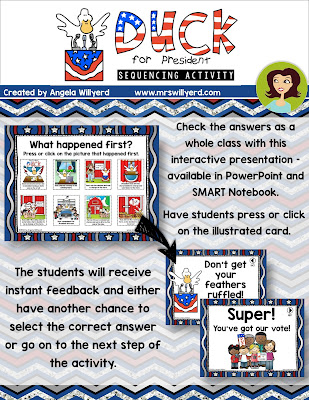
Kids get a kick out of checking their answers using an interactive PowerPoint or SMART Notebook resource.

Students are asked to press or click on the correct card and receive immediate feedback to either try again or go on to the next step of the activity.

This is a great way to get the class up and moving!

Do you love this activity?  Don't want to recreate the wheel?  Then, take a look at this no prep resource in my TeachersPayTeachers store!
Duck for President Sequencing Activity Companion Resource for Presidents' Day or Election DayDuck for President Sequencing Activity Companion Resource for Presidents' Day or Election Day


Tuesday, September 8, 2015

How to Teach Good Procedure Writing: PB and No J Scientific Method Demonstration

I love teaching the scientific process
to start off the beginning of the year. It's the foundation for all other good scientific work that we will do throughout the entire academic year. I introduce the importance of good procedure writing with a fun and memorable demonstration called PB & No J.

Students are asked to write some steps for how to make a peanut butter sandwich as a type of pre-assessment. I usually walk around the room to observe the different skill levels of the students, since many of my students come to me with various scientific inquiry experiences. Then, I have a few volunteers to participate in the first part of the demonstration. Students experience poorly written procedures when trying to make a peanut butter sandwich. The student trying to make the sandwich in this demonstration automatically adds the unwritten steps since they have probably made a peanut butter sandwich before. It's a lot of fun for the class when the teacher polices this demonstration and calls the student out. "Did the instructions say to do that?" The classmates usually start shouting out ideas for what should be done, but as the teacher and facilitator, you want to get the point across that there is a lot of wiggle room with these procedures. You just
never know what should actually be done and need to do some guessing. That does not make for a clear and consistent procedure. I do allow students to be creative in opening the peanut butter jar and eating the sandwich - as long as it isn't with their hands. Always pick a student for this part of the demonstration who is generally outgoing and boisterous. You will know the perfect kid for each class who will help make this activity memorable.

The second part of the demonstration shows the students an example of well-written procedures. I usually try to over-emphasize on the detail, and then try to tell the kids that their procedures need to be a happy medium between the poor procedures and the extremely detailed procedures. Once the students have experienced both demonstrations, then I have them review the procedures they had written at the beginning of the activity. I ask them to self-assess on a rubric, and then have any super confident junior scientists try their hand at reading their procedure for someone to follow in front of the class. This is a great opening for a few other lab experiences that will provide the opportunity for students to continue refining their procedure writing skills. I can tell a HUGE difference in the student writing when I explicitly teach procedure writing with this activity versus years when I only mentioned how it was important to include detailed steps. PB & No J definitely makes an impression!

Do you love this activity but don't have a ton of time to think about writing all those procedures? Download the handout with a self-assessment rubric and t-chart as well as a corresponding PowerPoint on my TpT store here!


sig signup3 photo blog sig signup3.png